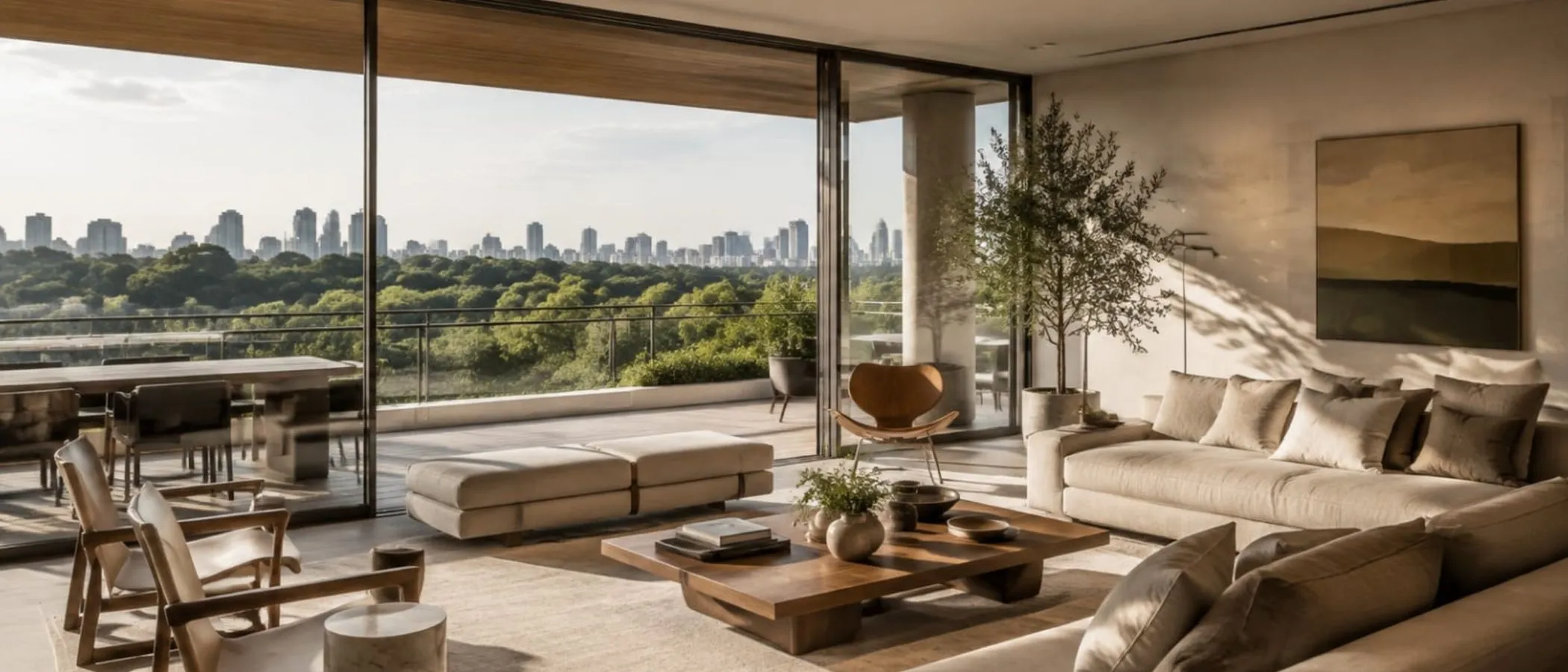
What Defines a Ultra-Luxury Property in São Paulo Today
True high-end real estate can no longer be measured only by square footage, the number of suites, or the prestige of the address. These attributes remain relevant, but they represent only the starting point.
In São Paulo, more experienced buyers have begun to assess a much broader combination of factors: architectural quality, privacy, comfort, location, security, operational efficiency, and asset preservation potential.
This shift reflects a more mature understanding of luxury. An exceptional property is not one that merely impresses on the first visit, but one that continues to make sense after years of use.
Luxury Is Quality Felt in Everyday Life
For a long time, the market associated high-end living with large spaces, ostentatious finishes, and an extensive list of amenities. Today, the analysis is more discerning.
The buyer looks at how the spaces connect, whether circulation is functional, whether there is privacy between social and private areas, and whether the floor plan fits their routine. They also consider natural light, ventilation, acoustics, and the relationship between the apartment and the view.
A residence may have generous dimensions and still present poorly used spaces. Likewise, a more rational layout can convey spaciousness, comfort, and sophistication when it has proper proportions and a well-resolved design.
Contemporary luxury is less about excess and more about precision. Every choice must have a reason: the size of the living room, the placement of windows, the quality of materials, the integration of spaces, and the way architecture responds to the lives of its residents.
Floor Plans That Adapt to Different Moments
A ultra-luxury residence must be flexible without losing its identity.
Families change, children grow, professional habits evolve, and new needs emerge. That is why properties with adaptable layouts and strong customization potential tend to remain desirable for longer.
A room can function as an office, library, intimate lounge, or entertaining space. A kitchen can be integrated with the social area on certain occasions and kept separate on others. Bedrooms should offer seclusion, while living rooms and terraces need to accommodate gatherings naturally.
This flexibility does not mean creating generic spaces. On the contrary: it means offering a solid architectural foundation so that each resident can create a truly personal home.
Well-Being Starts Inside the Property
Fitness centers, pools, spas, and sports courts add value, but well-being is not limited to the condominium’s leisure areas.
It begins inside the residence.
It is in the quiet at night, in the light that moves through the rooms, in the comfortable temperature, in air quality, in privacy, and in the sense of security. It is also in the ability to work, rest, entertain, and live together without one activity interfering with another.
Acoustic comfort has gained particular importance in São Paulo’s most valuable neighborhoods. Being close to restaurants, services, schools, and business centers is convenient, but that proximity should not come at the expense of privacy and quiet.
High-performance windows, good sealing, and appropriate construction solutions may seem like technical details during a visit. In practice, they are characteristics experienced every day and directly shape the living experience.
The building’s autonomy has also taken on greater importance. Generators with broad coverage, security infrastructure, properly sized elevators, and reliable systems help preserve daily routines even in a large city’s constraints.
Location Must Be Assessed Beyond the Neighborhood Name
In a market like São Paulo’s, it is not enough to choose a prestigious neighborhood. It is necessary to understand the specific quality of each address.
Within the same region, just a few blocks can represent major differences in quiet, mobility, tree cover, views, security, and liquidity. The building’s position, the unit’s orientation, the quality of the surroundings, and the possibility of future developments nearby must all be evaluated individually.
Vila Nova Conceição, Jardim América, Itaim Bibi, Jardim Lusitânia, and Cidade Jardim, for example, bring together some of the city’s most sought-after addresses. However, each micro-location has its own characteristics and serves different lifestyles.
Proximity to Ibirapuera Park, tree-lined streets, easy access, and the limited availability of land are elements that help sustain demand over time.
A good location represents more than convenience. It also acts as a form of asset protection, especially when its qualities are scarce and difficult to replicate.
Architecture and Technical Performance Gain Importance
The appearance of a property is easy to perceive. Its construction quality requires closer observation.
Well-advised buyers analyze the façade execution, window and frame quality, acoustic performance, waterproofing, climate control, electrical infrastructure, and the efficiency of the building’s systems. They also consider ease of maintenance and the property’s maintenance history.
Generous ceiling heights, wide openings, and quality materials create effects that go beyond aesthetics. They influence lighting, ventilation, durability, and the sense of comfort.
The same applies to the integration of architecture, interiors, and landscaping. When these disciplines are conceived coherently, the residence develops a clear identity and ages better.
In ultra-luxury real estate, value lies both in what is seen and in what remains invisible during an initial visit.
Interiors with Identity and Longevity
Overly standardized spaces tend to age quickly. The contemporary high-end residence seeks to express its residents’ personalities rather than reproduce a fleeting aesthetic.
Natural materials, well-executed millwork, carefully selected stone, quality fabrics, and understated metals help create sophisticated spaces without relying on excess.
Art also plays a central role. Paintings, photographs, sculptures, and design pieces are not just decorative elements: they build the home’s identity.
To properly accommodate a collection, the property must offer suitable walls, planned lighting, sightlines, and circulation areas that allow each piece to be appreciated.
Lasting sophistication emerges precisely from this combination of consistent architecture and personal expression.
Privacy Has Become an Asset
In ultra-luxury properties, privacy does not mean only having one apartment per floor or a private elevator.
It involves the building’s design, access control, discreet service areas, protection from neighboring properties, and the ability to use the spaces without unnecessary exposure.
It also extends to the transaction itself. Owners and buyers in this segment value discreet processes, accurate information, and a presentation consistent with the importance of the asset involved.
For this reason, a significant share of the best opportunities may not appear on traditional portals. These are properties sold confidentially, through relationships built over time.
Sustainability Must Deliver Real Benefit
In the premium segment, sustainability should not be just an institutional talking point.
It must appear in concrete solutions: better use of natural light, energy efficiency, water management, durable materials, thermal comfort, and systems that reduce waste without compromising the resident experience.
These features help lower operating costs, facilitate upkeep, and prepare the property for future demands.
More than following a trend, this is about creating residences capable of remaining efficient and desirable for many years.
The Asset Perspective Requires Selectivity
Anyone acquiring a ultra-luxury property should also consider its ability to preserve value.
Liquidity in this market does not necessarily mean selling quickly. It means there is consistent demand for that property type, that location, and the features it offers.
Units with protected views, well-resolved floor plans, recognized buildings, and truly scarce locations tend to weather market fluctuations better. Properties that are overly customized, have disproportionate condominium fees, or present technical issues may face more resistance in a future sale.
It is also important to distinguish asking price from actual traded value. Listings show owners’ expectations; completed transactions reveal the market’s real behavior.
Responsible asset decisions require comparing both, understanding the property’s specifics, and evaluating available alternatives within the same investment range.
Curated Selection Has Become an Essential Part of Buying
The abundance of information has not necessarily made the choice simpler.
Photographs can overstate certain spaces. Descriptions can omit limitations. Similar square footage can conceal major differences in site placement, layout, maintenance, and construction quality.
That is why the role of specialized advisory services is not just to present properties. It is to interpret the market, filter opportunities, identify risks, compare values, and understand what truly makes sense for each buyer.
In ultra-luxury real estate, the best decision is often not to buy the first property that makes an impression. It is to recognize the one that combines quality of life, fit with daily routine, and asset consistency.
What Remains After the First Impression
An exceptional property must be evaluated beyond its initial appeal.
When the décor is replaced and the novelty fades, what remains is the location, architecture, view, natural light, quiet, privacy, and construction quality.
These are the attributes that turn a residence into an asset.
In São Paulo, true ultra-luxury lies in properties that can combine an extraordinary living experience with objective qualities that are difficult to reproduce. These are properties chosen not only for what they represent today, but for their ability to remain relevant in the future.